What? Strange to think your fingers have memory but what I mean is the coordination between your mind and the muscles in your fingers. The number one reason people give up playing guitar is because they don't get past the finger training stage. Who is the finger trainer than? You are! You are the only one that can make that connection between your brain and your fingers to get them to work together and do what you want them to.
It's just like riding a bike you had to train yourself to balance, shove off and switch to pedaling all the while keeping your balance. I can teach you where to put your fingers but you have to put them there! Only you can make yourself good at it. This is the hardest thing you will ever have to learn! But the teacher is you.. so start teaching yourself now!
Here are a few good exercises to help coordinate your brain and fingers:
Pull-offs/Trills
Pull-offs and trills are great exercises to build hand strength and are a necessary element to lead guitar playing. The idea is to: hold the string with one finger and pull it off the string to the point where it feels as if the meat of your finger is plucking the string... You'll feel the string snap out from underneath the finger and in so doing the note you hold behind the one you just pulled off from will ring.

A trill is the process of hammering a finger down on a string and pulling of repeatedly. The hammer action causes a note to sound and pulling it off so that the note fingered behind it sounds. The only difference between a pull-off and a trill is that a trill is repeatedly really fast.
Readmore - Finger Memory
It's just like riding a bike you had to train yourself to balance, shove off and switch to pedaling all the while keeping your balance. I can teach you where to put your fingers but you have to put them there! Only you can make yourself good at it. This is the hardest thing you will ever have to learn! But the teacher is you.. so start teaching yourself now!
Here are a few good exercises to help coordinate your brain and fingers:
Pull-offs/Trills
Pull-offs and trills are great exercises to build hand strength and are a necessary element to lead guitar playing. The idea is to: hold the string with one finger and pull it off the string to the point where it feels as if the meat of your finger is plucking the string... You'll feel the string snap out from underneath the finger and in so doing the note you hold behind the one you just pulled off from will ring.
A trill is the process of hammering a finger down on a string and pulling of repeatedly. The hammer action causes a note to sound and pulling it off so that the note fingered behind it sounds. The only difference between a pull-off and a trill is that a trill is repeatedly really fast.
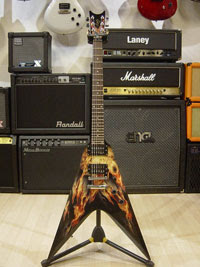 Drop D tuning (commonly known as 'dropped d') is very very very simple to get. Usually we can easily find this kinda trick when you hear about heavy metal stuffs.. I prefer to call it the industrial rock, rock music today.
WHATEVER.. Lol..!!!
I'M IN CHARGE MISTER!!! Lmao!!!
It's easy ... All you have to do is lower the tone E (6th string) to D. Anticipation of its similarity to pluck the strings 4th (D string) and then pick the low E that you have sent down earlier. See what I've done below...

You guys don't need some hard move to your guitar power chords to get sound in tune, once you get that just like I said, it RULES!!!
 Harmonics are bell-like sounds that are achieved in various ways. For those of you who haven't done these before, i would recommend starting with the easiest. All you do is lightly touch each string directly over the 12th fret with any left-hand finger. Strike the string and release the finger immediately.
The notes on the musical notation have a diamond shape and above the stave you will see 8va which indicates that the notes sound an octave higher.
The other 'easy' Harmonics are at the 5th, 7th and 9th also don't forget the 12th frets. However, this time you will find that the notes produced by these harmonics are not the same as notes indicated on the tablature. In other words, if you look at this, where the strings are touched directly over the 5th fret, the notes themselves are E A D G B E, 6 5 4 3 2 1
Harmonics at 5th fret.
Notes produced are : E A D G B E

Harmonics at 7th fret.
Notes produced are : B E A D F# B

Harmonics at 9th fret.
Notes produced are : G# C# F# B D# G#

Harmonics at 12th fret.
Notes produced are : E A D G B E
